What Norwegian 5-Year-Olds Can Do That Would Shock American Parents
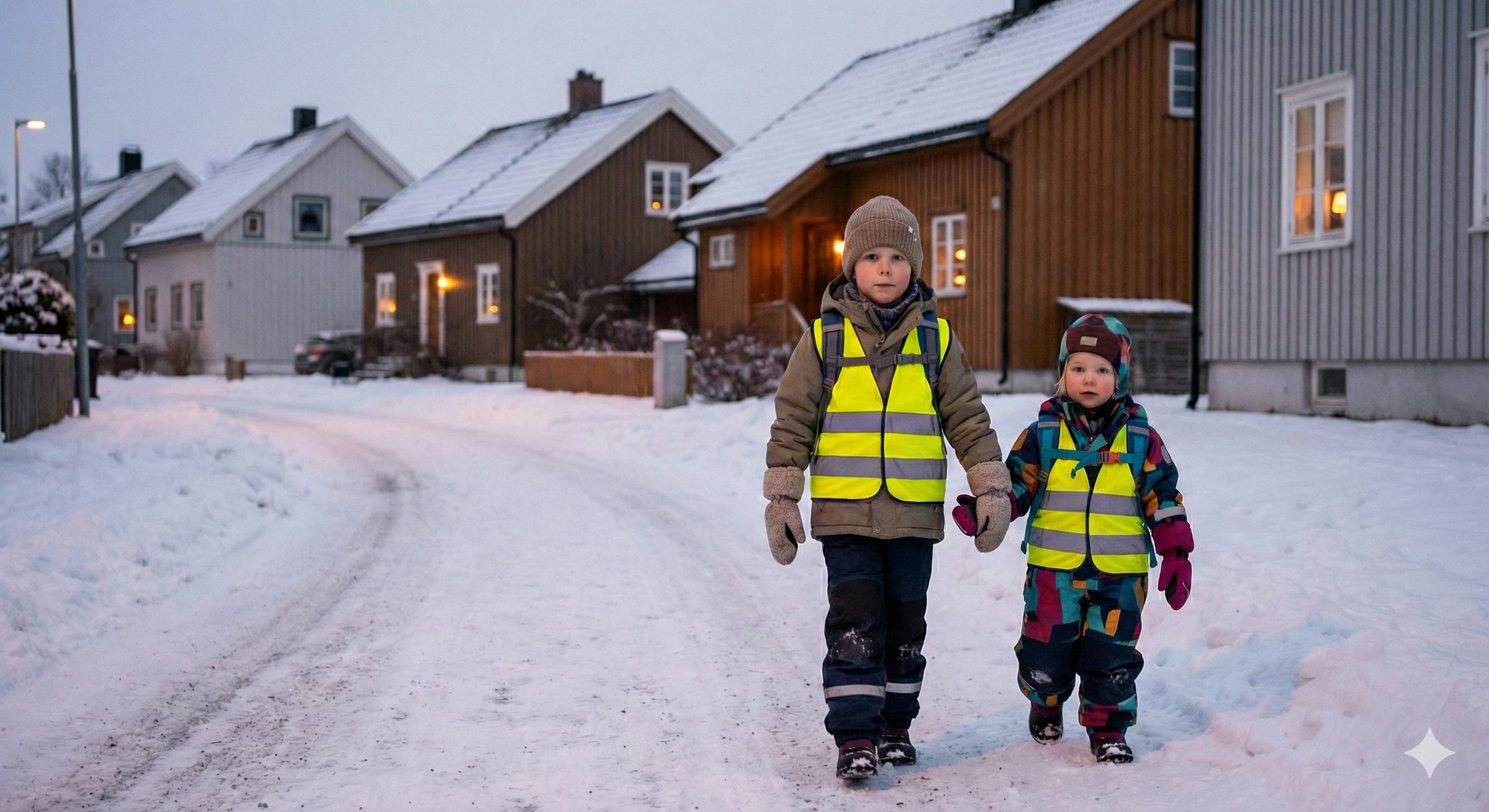
Spoiler: It involves knives, rain, and a lot of trust
The First Time I Saw It
I remember the first time I saw a six-year-old walk out of school, wave goodbye to the teacher, and head home alone. No parent waiting at the gate. No older sibling. Just a kid with a backpack, walking down the street like it was the most normal thing in the world.
Because here in Norway, it is.
I work at a Norwegian school with first and second graders, and I'm also raising my four-year-old daughter here. Every day I see kids doing things that would make many American parents gasp. Not because Norwegian children are superhuman, but because they're trusted to be capable from a very young age.
And honestly? They live up to that trust.
Things Norwegian Kids Do That Might Shock You
1. First Graders Walk Home Alone
This is the one that surprises people the most. In Norway, it's completely normal for six and seven-year-olds to walk home from school by themselves. They know the route, they follow the traffic rules, and they let themselves into the house.
No one panics. No one calls the police. It's just Tuesday.
The first few times I saw this, I had to adjust my expectations. But then I watched how confident these kids are. They've been preparing for this kind of independence since they were toddlers.
2. Kids Pick Up Their Younger Siblings from Kindergarten
This one really got me. I work with first graders who are around six years old, and one day I got a message from a mother saying her son could go home on his own. That part was pretty normal for me by now.
But then she added: "Can you remind him to pick up his little brother from barnehage on his way home?"
I had to read it twice. A six-year-old was expected to walk out of school, go to the kindergarten, pick up his four-year-old brother, and take him home. Just like that, as part of his Tuesday afternoon.
And you know what? He did it. No stress, no drama. He knew the way, he knew the routine, and his little brother was excited to see him.
In Norway, this isn't unusual. Older siblings regularly pick up younger ones from barnehage, and the kindergarten staff are used to it. They know the families, the child signs out their sibling, and off they go walking home together.
It teaches responsibility in a way that no chore chart ever could. That six-year-old wasn't just going home. He was trusted with his little brother's safety, and he took that seriously.
3. Four-Year-Olds Use Real Knives
Walk into any Norwegian barnehage and you might see something that would alarm most American parents: a group of four-year-olds sitting around a table, each holding a real knife. Not plastic, not blunt. Real and sharp.
They use them to cut fruit for snack time, slice bread, and even whittle sticks during outdoor play. The teachers show them how to hold the knife properly, how to always cut away from their body, and how to respect the tool. After that, the kids are trusted to practice on their own.
Do they sometimes get small cuts? Yes. Do they learn from it? Absolutely. A tiny nick teaches more about knife safety than a hundred warnings ever could.
The philosophy behind this is simple: if you never let children handle risk, they never learn how to manage it. By the time these kids are five or six, they're confident and careful with tools that many adults would hesitate to hand them.
4. Kids Play Outside in All Weather
Rain, snow, sleet, wind. Norwegian kids are outside regardless of what the sky is doing. There's a famous saying here: "There's no bad weather, only bad clothing."
At my daughter's barnehage, they spend hours outside every single day. In the rain, they put on full rain suits and splash in puddles. In the snow, they build and dig and roll around until their cheeks are red.
American parents sometimes ask me: Don't they get sick? The answer is no, not really. Fresh air and outdoor play actually keep kids healthier. And the resilience they build is incredible.
5. Kids Climb Trees and Rocks Without an Adult Spotting Them
At playgrounds and in nature, Norwegian kids climb. High. And adults don't stand underneath with their arms out, ready to catch them.
The expectation is that children will assess the risk themselves. They'll climb as high as they feel comfortable, and they'll come down when they're ready. If they fall, they learn something about their own limits.
This was hard for me at first. Every instinct told me to hover under my daughter when she climbed. But I've learned to step back and watch. She's more careful and more confident than she would be if I was always there to catch her.
6. Young Kids Have Real Duties at School
When I started working at a Norwegian school, I wasn't prepared for what I saw. I was raised in Asia where the school culture is completely different, and some things here genuinely shocked me.
The biggest surprise came at the end of the school day. In the last fifteen minutes, the classroom transforms into a cleaning operation run entirely by six and seven-year-olds. One group empties the trash bins and carries the bags out. Another group grabs brooms and sweeps the floors. Others wipe down the tables with cloths and make sure everything is tidy for tomorrow. Then someone mops.
There's no cleaning staff waiting for the kids to leave. There's no teacher doing it after hours. The children take care of their own space, and they do it like it's the most natural thing in the world. Because for them, it is.
Another thing that caught me off guard was the shoe system. Every child has two pairs of shoes: one for indoors and one for outside. When they arrive in the morning, they swap into their indoor shoes at the entrance. When it's time to go outside for play, they switch again. Back inside, another switch. Even the youngest children handle this without anyone telling them what to do.
It sounds like a small thing, but it's not. It teaches children to be aware of their environment, to keep shared spaces clean, and to take responsibility for themselves without waiting for an adult to give instructions.
Where I grew up, adults took care of all this. Classrooms were cleaned by staff, shoes weren't something children thought about, and the focus was purely on academics. Watching these young kids own their space and contribute to their school community made me realize how much independence children are capable of when we expect it from them.
7. Kids Spend Time in Nature Without Adults Hovering
One afternoon I was at a park near our home and saw a group of kids, maybe seven or eight years old, disappear into a small wooded area at the edge of the playground. No parents followed them. No one called them back. They were just gone, into the trees.
I looked around expecting someone to go after them. Nobody moved. The parents on the benches kept chatting, completely unbothered.
Twenty minutes later the kids emerged, covered in dirt, carrying sticks they'd collected, talking excitedly about a stream they'd found. Their parents glanced over, nodded, and went back to their conversations.
In Norway, this is normal. Kids are trusted to explore nature on their own or with friends from a young age. By seven or eight, many children go into nearby woods to play without an adult watching over them. They build forts, climb trees, wade through streams, and figure out how to navigate uneven terrain. They come home muddy, scratched, and completely happy.
Coming from a culture where children are rarely out of sight, this took some getting used to. But I've started to see the wisdom in it. These kids aren't just playing. They're learning to assess their environment, solve problems, and trust their own judgment. And they're doing it in a world that isn't padded or supervised, which is exactly what makes it valuable.
Why Does This Work?
You might be wondering: How can Norwegian parents be so relaxed? Isn't this dangerous?
I asked myself the same questions when I first moved here. How can they just let a six-year-old walk home alone? How is no one worried about the kids in the forest? It felt reckless to me at first.
But the more I watched, the more I understood. Norwegian children aren't thrown into independence. They're prepared for it, step by step, from the time they're toddlers.
A three-year-old learns to put on their own rain gear. A four-year-old learns to handle a real knife safely. A five-year-old walks a little ahead on the trail and makes decisions about which path to take. By the time they're six and walking home from school alone, they've had years of practice making small choices and handling small risks.
The other part of it is that Norway is set up to support this. Communities are designed with children in mind. Drivers expect kids on the streets. Schools and kindergartens teach practical life skills alongside academics. And culturally, there's a shared belief that children are capable until proven otherwise, not fragile until proven capable.
I've seen this shift in my own parenting too. When I first arrived, I would hover close to my daughter at the playground, ready to catch her if she fell. Now I sit on the bench like the Norwegian parents do. I watch from a distance. I let her climb higher than I'm comfortable with and solve problems on her own before I step in.
It's not that I care less. It's that I've learned to trust more. And every time she manages something I thought was beyond her, I realize she was ready all along. I was the one who needed to catch up.
What American Parents Can Take From This
I'm not saying American parents should send their first graders out the door alone tomorrow. Every community is different, and safety considerations vary.
But I do think there's something valuable in the Norwegian approach that any parent can adopt: the belief that children are capable.
Start small. Let your child struggle with their jacket zipper a little longer before helping. Let them climb a bit higher than feels comfortable. Give them a real task in the kitchen. Walk a few steps behind them instead of beside them.
You don't have to move to Norway to raise an independent child. You just have to trust them a little more than feels easy.
And then watch them rise to meet that trust.
What's the most independent thing your child does? I'd love to hear about it in the comments!